
Twist-a-pull: Unraveling the Rare Encounter of Colo-Colic Intussusception Caused by Submucosal Lipoma
Article Sidebar
Main Article Content
Abstract
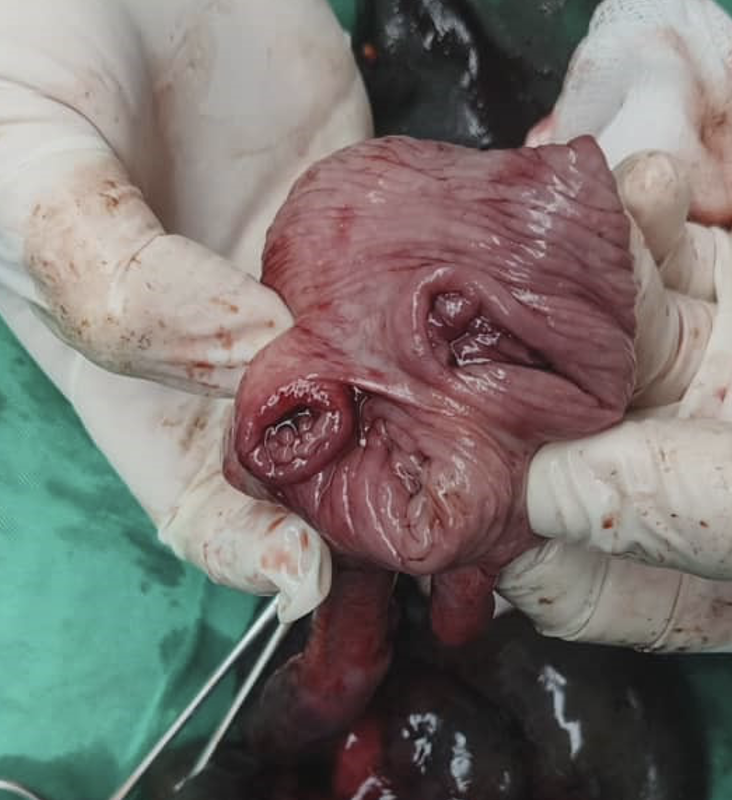
In adults, colo-colic intussusception is mainly associated with colonic malignancies, with CT scans identifying a lead point in 70-90% of cases. Benign causes, like submucosal lipomas, are less common, with incidences between 0.2% and 4.4%. This report describes a rare instance of right-sided colo-colic intussusception caused by a submucosal lipoma in a 72-year-old female. She presented with acute intestinal obstruction, sudden abdominal distension, and localized right lower quadrant pain, worsening over a week. CT imaging revealed ileo-colic intussusception. Intraoperatively, caecum-ascending colon colo-colic intussusception with proximal bowel obstruction was identified. A midline laparotomy, right hemicolectomy, and primary anastomosis were performed, with histopathology confirming a submucosal lipoma without malignancy. The patient had an uneventful recovery.
Submucosal colonic lipomas, typically asymptomatic, can cause intussusception, obstruction, bleeding, and abdominal pain, complicating diagnosis due to their similarity to malignancies. They are most common in the ascending colon/caecum, followed by the sigmoid, descending, and transverse colon, and should be considered in differential diagnoses. Although benign lesion-induced intussusception is rare in adults, accurate diagnosis and timely intervention are crucial to prevent complications. Pre-operative identification is challenging due to non-specific symptoms, but CT scans are invaluable for diagnosis, effectively pinpointing the tumor site as a lead point
Downloads
Article Details

This work is licensed under a Creative Commons Attribution-NonCommercial 4.0 International License.
This is an open-access journal, which means that all content is freely available without charge to the user or his/her institution. Users are allowed to read, download, copy, distribute, print, search, or link to the full texts of the articles, or use them for any other lawful purpose, without asking prior permission from the publisher or the author. This is under the BOAI definition of open access.
The journal is adopting the Creative Commons International Attribution 4. CC Attribution-NonCommercial 4.0CC BY-NC 4.0].
All articles published in BJSS are licensed under a Creative Commons Attribution 4.0 International (CC BY -NC 4.0) license. This permits unrestricted use, distribution, and reproduction in any medium, provided the original work is accurately cited.
Authors retain full copyright of their work. By submitting to BJSS, and once published, any third party may use the article freely provided the original authors, citation details, and publisher are clearly identified.
You are free to:
- Share— copy and redistribute the material in any medium or format
- Adapt— remix, transform, and build upon the material
- for any purpose
- The licensor cannot revoke these freedoms as long as you follow the license terms.
Under the following terms:
-
- Attribution — You must give appropriate credit , provide a link to the license, and indicate if changes were made . You may do so in any reasonable manner, but not in any way that suggests the licensor endorses you or your use.
- NonCommercial — You may not use the material for commercial purposes .
- No additional restrictions — You may not apply legal terms or technological measures that legally restrict others from doing anything the license permits.
Notices:
You do not have to comply with the license for elements of the material in the public domain or where your use is permitted by an applicable exception or limitation.
No warranties are given. The license may not give you all of the permissions necessary for your intended use. For example, other rights such as publicity, privacy, or moral rights may limit how you use the material.
- https://creativecommons.org/licenses/by-nc/4.0/