
Little Person With A Giant Umbilical Cord
Article Sidebar
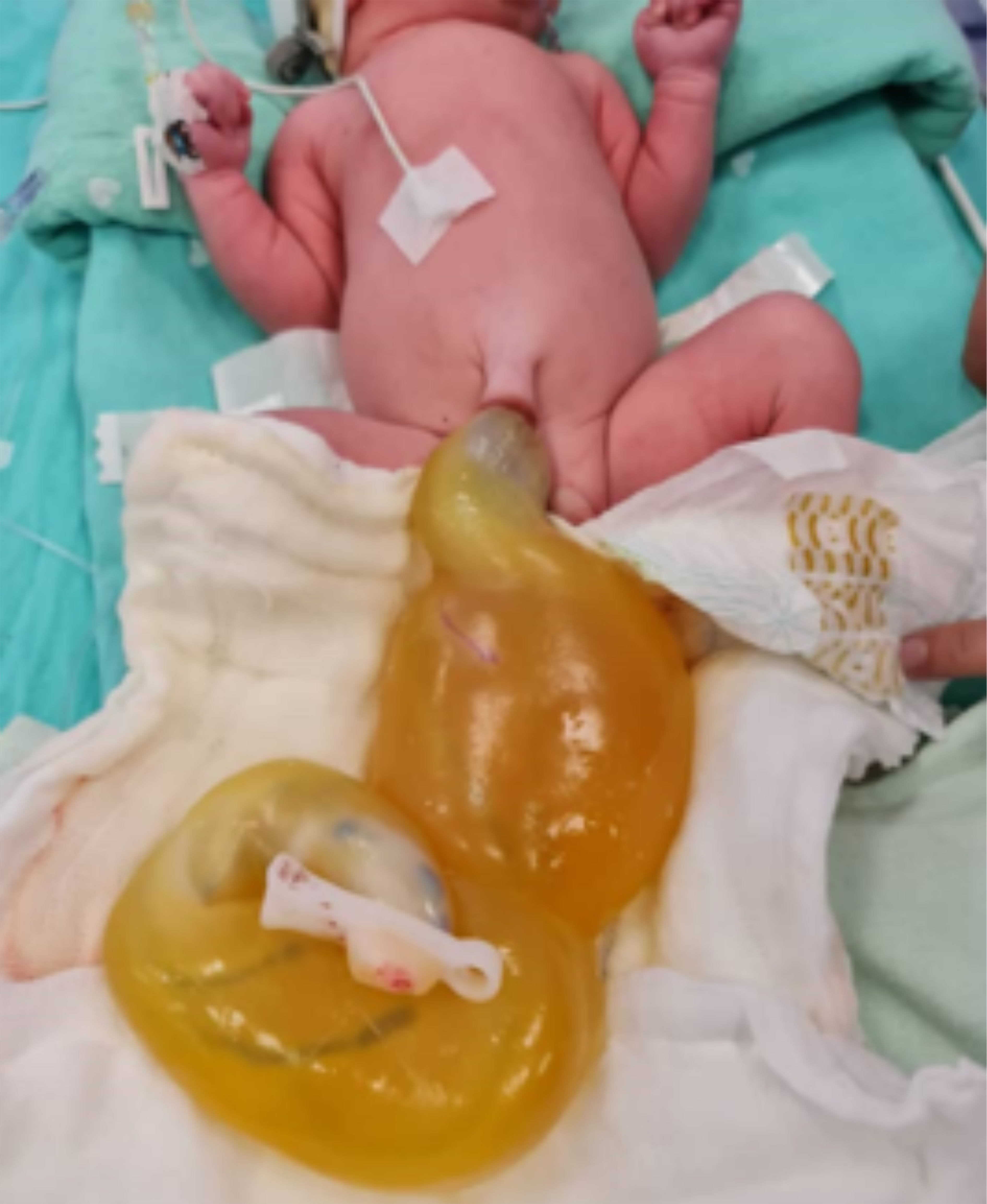
Main Article Content
Abstract
The giant umbilical cord is a rare anomaly that is usually detected in the antenatal period and is
distinctive at birth. It is a condition where the diameter of the cord is more than 5 centimeters
in diameter. A normal umbilical cord measures approximately 2 centimeters in diameter. We
present a case of a giant umbilical cord in a male baby, in whom this condition was diagnosed
antenatally. At birth, its appearance is pathognomonic with a large, thickened cord filled with
viscid fluid called Wharton’s jelly. The umbilical vessels were apparent from the surface of the
cord. Surgical exploration which was done revealed no patent urachus. It is pertinent to rule out
other associated anomalies or differential diagnoses when encountering this condition.
Keywords : Umbilical anomaly, giant umbilical cord, umbilical pseudocyst
Downloads
Article Details

This work is licensed under a Creative Commons Attribution-NonCommercial 4.0 International License.
This is an open-access journal, which means that all content is freely available without charge to the user or his/her institution. Users are allowed to read, download, copy, distribute, print, search, or link to the full texts of the articles, or use them for any other lawful purpose, without asking prior permission from the publisher or the author. This is under the BOAI definition of open access.
The journal is adopting the Creative Commons International Attribution 4. CC Attribution-NonCommercial 4.0CC BY-NC 4.0].
All articles published in BJSS are licensed under a Creative Commons Attribution 4.0 International (CC BY -NC 4.0) license. This permits unrestricted use, distribution, and reproduction in any medium, provided the original work is accurately cited.
Authors retain full copyright of their work. By submitting to BJSS, and once published, any third party may use the article freely provided the original authors, citation details, and publisher are clearly identified.
You are free to:
- Share— copy and redistribute the material in any medium or format
- Adapt— remix, transform, and build upon the material
- for any purpose
- The licensor cannot revoke these freedoms as long as you follow the license terms.
Under the following terms:
-
- Attribution — You must give appropriate credit , provide a link to the license, and indicate if changes were made . You may do so in any reasonable manner, but not in any way that suggests the licensor endorses you or your use.
- NonCommercial — You may not use the material for commercial purposes .
- No additional restrictions — You may not apply legal terms or technological measures that legally restrict others from doing anything the license permits.
Notices:
You do not have to comply with the license for elements of the material in the public domain or where your use is permitted by an applicable exception or limitation.
No warranties are given. The license may not give you all of the permissions necessary for your intended use. For example, other rights such as publicity, privacy, or moral rights may limit how you use the material.
- https://creativecommons.org/licenses/by-nc/4.0/
References
Young S, McGeechan A, Davidson P, et al. Arch Dis Child Fetal Neonatal Ed 2016;101:F538–F539.
Moshiri, Mariam, et al. “Comprehensive Imaging Review of Abnormalities of the Umbilical Cord.” RadioGraphics, 1 Jan. 2014, https://pubs.rsna.org/doi/10.1148/rg.341125127.
Dudiak CM, Salomon CG, Posniak HV, Olson MC, Flisak ME. Sonography of the umbilical cord. RadioGraphics 1995;15(5):1035–1050
Nobuhara KK, Lukish JR, Hartman GE, Gilbert JC. The giant umbilical cord: an unusual presentation of a patent urachus. J Pediatr Surg. 2004;39(1):128–129
Mugarab Samedi, V, Miller, G, Saade, E, Kalaniti, K. A giant umbilical cord: Benign finding or surgical emergency? Clin Case Rep. 2020; 8: 398– 399. https://doi.org/10.1002/ccr3.2663
Naiditch JA, Radhakrishnan J, Chin AC. Current diagnosis and management of urachal remnants. J Pediatr Surg. 2013;48(10):2148-2152.
Wildhaber BE, Antonelli E, Pfister RE. The giant umbilical cord. Archives of Disease in Childhood - Fetal and Neonatal Edition 2005;90:F535-F536
Rosner-Tenerowicz A, Florjanski J, Paslawski W, Piatek A, Zimmer M. Cystic dilatation of umbilical cord associated with patent urachus. Ginekol Pol. 2021;92(8):595-596. doi: 10.5603/GP.a2021.0156
Young, Simone; McGeechan, Anne; Davidson, Patricia; Deshpande, Aniruddh (2016). Management of the giant umbilical cord: challenging the need for investigations in the newborn. Archives of Disease in Childhood - Fetal and Neonatal Edition, 101(6), F538–F539. doi:10.1136/archdischild-2016-311092